

When a Black woman's intellect is de-platformed from the institution of the newsroom or network, we ache. Then we see opportunity.
Joy-Ann Reid's firing from MSNBC made me want to remind you of the Soledads, Melissas, Jacques and Black women we've lost, better yet GAINED, when their voices were abruptly "de-platformed."

February 25, 2025-Last night we bid farewell to #TheReidOut as we know it. The show’s toss to the next host marked the end of an era in the most dystopian of times, arguably stripping America of its strongest Black voice of clarity and common sense in primetime television.
The program solidified a Black American woman-the daughter of a Congolese father and a Guyanese mother- as one of the nation’s leading, most authoritative voices in coverage committed to a pro-democracy lens.
Joy-Ann Reid’s steady, intellectual monologues and dialogues spoke truth to power in the years leading up to and during this fascist moment. Monday night’s show ended her near decade-long streak on MSNBC. What started as a weekend morning show graduated to a necessary space for primetime prose that was anchored in Reid’s clear, concise undressing of the times. Some of us heard Reid’s reaction to the news in real-time Sunday evening, just hours after details surfaced about her and her staff’s abrupt firing from the network.
“My show had value…and that it mattered,” she said.
Yes, it did.
That evening, during an emergency coalition call that reached a 10,000 participant Zoom meeting max and overflowed onto YouTube, Reid held back tears. She began to list issues that she’d tackled head-on and before a national audience on The Reid Out. From violence against Asian Americans and babies bombed in Gaza, she remained unapologetic. From the Black Lives Matter movement and issues facing immigrants in a nation built on the backs of the enslaved, she remained unapologetic. And she took it all the way to the countless examples of the president committing to actions that Reid accurately called “subversive to the constitution.”
“My show had value…and it mattered…I’m not sorry that I stood up for those things because those things are of God…I’m not sorry. I’m just proud of my show.” -Joy-Ann Reid, February 23, 2025
“Where I come down on that, is that I’m not sorry,” Reid declared. “I’m not sorry that I stood up for those things because those things are of God and you know, I’m a church girl, too and those are the things I was taught were of God.”
“I’m not sorry, I’m just proud of my show.”
While some may point to the sweeping changes and anchor shuffling announced within 24 hours of Reid’s news as a reasonable explanation for the sudden demolition of her show, this cannot be framed as simply a business move for the betterment of the Peacock. It was Reid’s colleague and friend Rachel Maddow who laid bare a glaringly larger point when she properly used her own privilege and MSNBC platform to sound the alarm.
“I will tell you it is also unnerving to see that on a network where we’ve got two-count ‘em TWO- non-white hosts in primetime, both of our non-white hosts in primetime are losing their shows, as is Katie Phang on the weekend.” Rachel Maddow, February 24, 2025
“I will tell you it is also unnerving to see that on a network where we’ve got two-count ‘em TWO- non-white hosts in primetime, both of our non-white hosts in primetime are losing their shows, as is Katie Phang on the weekend,” Maddow said on her own show Monday evening.
“And that feels worse than bad, no matter who replaces them. That feels indefensible and I do not defend it.”
Reid’s final show earlier that evening was smart, as usual. It was centered on resistance. Resistance to authoritarianism. Resistance to the fact that what is inherently anti-Black is hurting a multi-racial democracy.
The show highlighted that the current U.S. authoritarian movement is led by a South African “apartheid clique.” Paul Butler, a former federal prosecutor and legal analyst reminded us of times in history that mirrored the sort of resistance that is required of us today. He invoked the spirit of Thurgood Marshall and Constance Baker Motley in his own history lesson about their work leading up to the landmark Brown v. Board of Education school desegregation case.
That farewell centered experts-historians and intellectuals like Ruth Bhan-Ghiat who have clear eyed ways for confronting these times. Nayera Haq pointed out that the decimation of global USAid amounts to slashing a fraction of the federal budget, yet carries an outsized weight in the propaganda meant to make you believe that government waste is being cut in good faith by a made-up agency led by an oligarch. Coupled with Ben Rhodes’s analysis of the moment, Reid pulled together the essential voices guided by her own rhythmic hosting and analytic skills so many have come to appreciate, especially in dark times.
And Joy looked good. Good in her #Reidout hoodie and as good as her authentic and energetic voice sounds. She looked good as her allies stood behind the studio cameras to wrap this sister in their arms. And that last wide shot of The Reidout Family was a good look at the people who brought us this evening Joy. Their faces served as a reminder of how abruptly the show ended and how dozens of people who brought this sharp, smart show to life every weeknight also lost their jobs unexpectedly on that Sunday morning.1
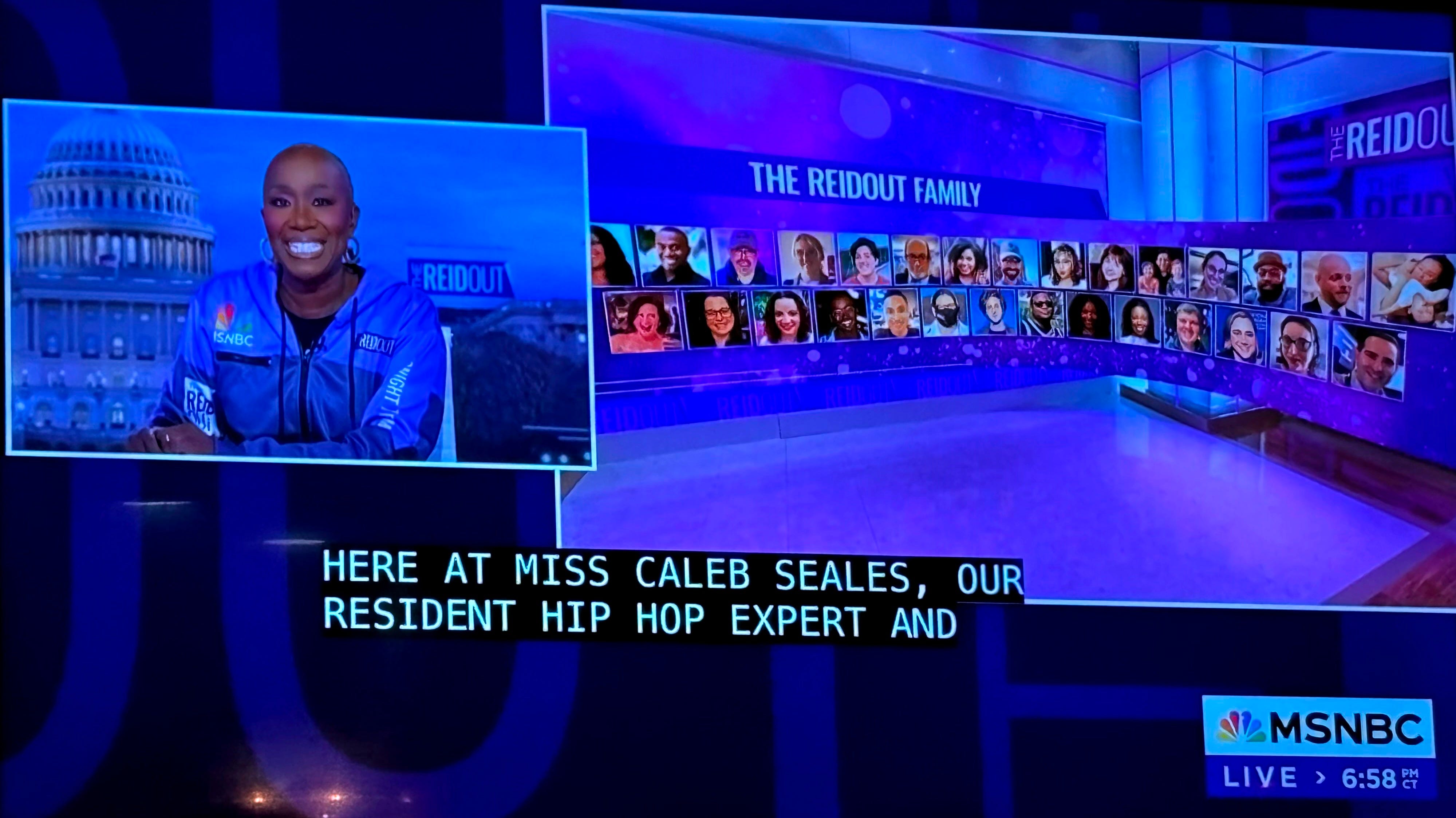
A photo from Carr’s television on the final night on the TheReidOut
What was perhaps most striking for me in the midst of this seismic transition was the way so many of my contemporaries shared our own Joy Ann Reid moments. Some held close friendships with her. Others have been supported or platformed by her. They joined others who simply possess a deep admiration and appreciation for Reid. Everyone shared photos, memories and affirmations of their “Joyful” moments.
I reserved mine for Fortify.
It was Joy-Ann Reid who platformed my 2020 investigation into a legitimate Georgia voter fraud case. She catapuled details of a consequential democracy crisis from the screens of local viewers here in Atlanta to the living rooms and devices of a national television audience. While state officials were holding press conferences about potential, mythical fraud that could be compromising election integrity “on both sides,” I’d uncovered and reported an actual case of voter fraud that resulted in a state investigation supported by a mound of video evidence. It involved a Republican Florida attorney who had illegally registered to vote using his brother’s Paulding County, Georgia address. He’d also instructed a room full of GOP voters to “cheat” by registering to vote using the same out-of-state address. This was an effort to ensure a win (and what would ultimately be a loss) for then-congressional candidates Kelly Loeffler and David Perdue.
Joy featured my reporting, called my name and brought awareness to the actual attempted fraud happening in the center of the Big Lie universe. You can check out the cell phone video of the segment that a co-worker sent me below and the original report here.
Cell phone video of Joy-Ann Reid featuring Carr’s 2020 voter fraud investigation in Georgia.
Now that we’re done with the recap, I want to recognize a few other times when the strongest and most important Black women voices on national television have faded to static , often with the excuse that it’s just business- the ratings aren’t good enough to support their presence. They’ve been replaced by white hosts with far less influence or resounding voices, or “de-platformed” in pursuit of a different audience.
In one case, that meant chasing those folks who loved a newly-minted King of reality TV named Donald Trump.
Let’s take it back to a woman who was the flyest, finest of them all on the late-night news scene in the early 2000s.
You know who I’m talking about. It was the good sis from Atlanta with the pixie-cut, perfect brows and girl-next-door face. Her name is Jacque Reid.
Now Jacque Reid did not provide the type of analysis that Joy Reid has brought to audiences, but I would compare her cultural influence and that of her programming’s to the appeal Joy’s presence has on diverse audiences.
What you got on BET Nightly News with Jacque Reid—which ran from 2001 to 2005- was multi-layered with a cherry on top. For one, Reid herself singlehandedly redefined what a news anchor looked like, commanding the audience’s attention with a swag that was true to her authentic style and fashion. Reid did not emulate the traditional female news anchor with that signature bob haircut or boxy blazer suit jackets fit we were taught to don in J-school. Instead, she wore flattering and daring cuts. She was so confident that she would have looked good in anything, but we appreciated everything she brought to the screen that gave us more Robin Givens and Halle Berry in Boomerang office style than it did Katie Couric and Ann Curry on the Today Show. No shade to Katie or Ann. I’m just pointing out what was considered the status quo.
News with Jacque Reid (2003) from YouTube user Foggy MelsonSecond, and most importantly, the types of short and long-form stories that Reid brought to the table with a lift from Black correspondents and producers completed a smartly-stacked rundown each night, giving viewers a look at Black America in a way that was not routinely broadcast on other nightly newscasts. Correspondent Andre Showell was showing us how federal government jobs were largely responsible for a Black upper-middle class long before we had to make this point in the midst of a federal workforce purge.
Listen to the cold-open in the 2003 video above (complete with jazz music) demonstrating the type of stories we got every night with Jacque Reid.
“Ahead here on the BET Nightly News, a special report. They make up a large portion of the most powerful military force in history but are African-American soldiers getting the recognition they deserve? Meanwhile U.S. forces have their hands full in Iraq as thousands call for the end of the U.S. occupation. Jesse Jackson leads the battle in a South Carolina county to recognize the King holiday. And the Matrix Reloaded driven by Black cast members is re-writing the record books at the box office…
This is the BET Nightly News…Our newscast with Jacque Reid covering our world, our issues and our culture…. the BET Nightly News starts right now.”
But the business of news found a way to justify cutting Reid’s show. Leaders with Viacom, which acquired the Black-owned network in a $2.3 billion dollar deal in 2000, cited low ratings and a thirst for a program lineup that would mirror some of the reality TV success on other networks. Specifically….now wait for it…NBC’s “The Apprentice.” Yes, that Apprentice with that Trump. Part of BET’s formula for success after scrapping Reid would include a show centered on Damon Dash as a “Trump-like” leader handing out Roc-A-Fella pendants as “The Ultimate Hustler.”2
How’d that work out?
Reid went on to do some lifestyle hosting in New York, but never dipped back into hard news—and BET never recovered what it ultimately lost with the absence of Nightly News.
But hey-it’s all about the ratings…
THE LIGHT OF SOLEDAD
Soledad O’Brien was and remains a prototype for practicing accountability journalism.
When she arrived to CNN from NBC in 2003 to hold down the morning anchor chair, she re-defined what it meant to helm a network television show.
Soledad brought us good ole’ fashioned shoe-leather reporting from the field, documentaries on the Black and Latino experience in America, and a memoir that made us re-think identity in America and how we reckon with race.
She’s a trusted, tried and true, no-nonsense fact-chaser.
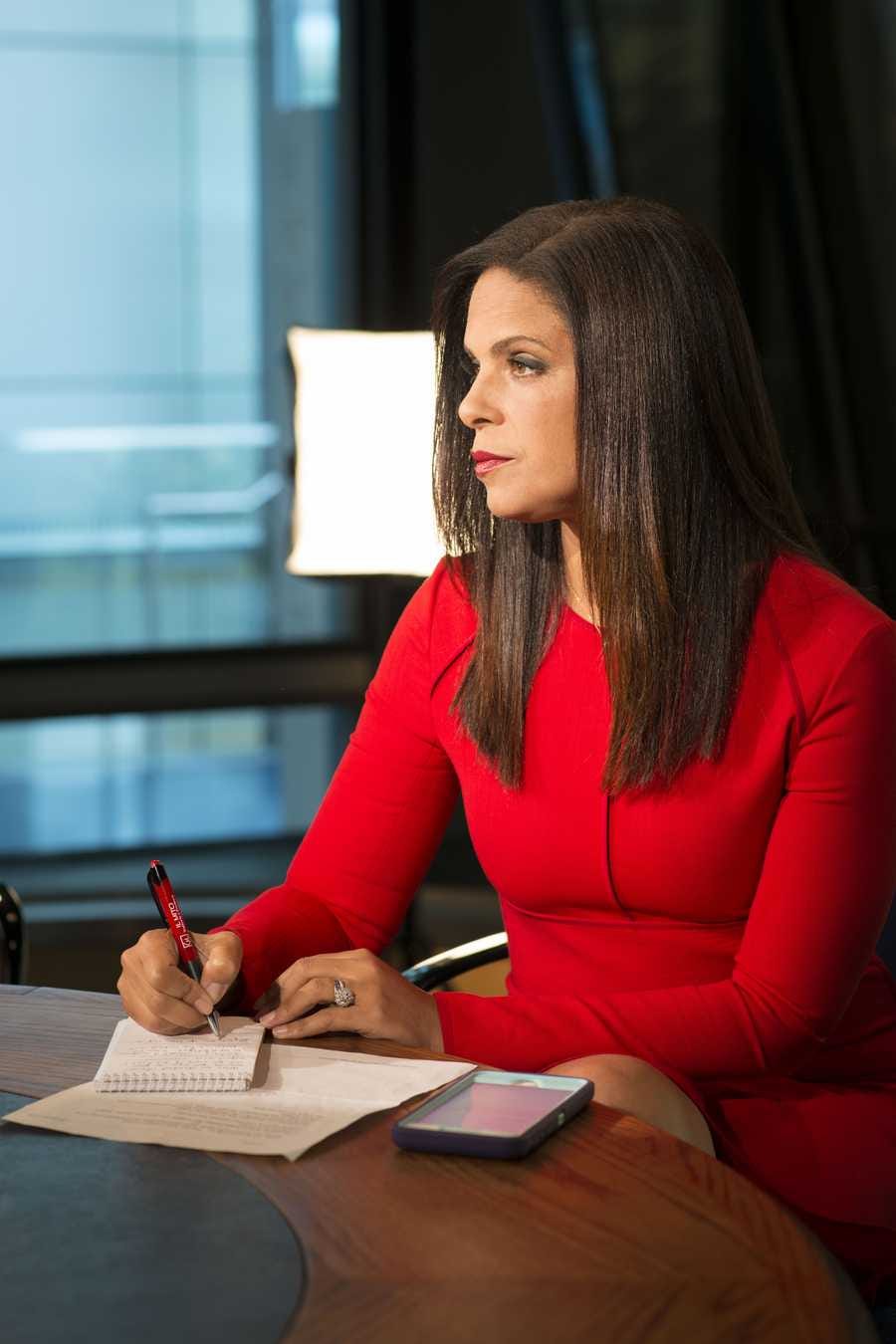
O’Brien on the set of her Matter-of-Fact program produced by her own production company for Heart Television stations/courtesy WBPF
Who can forget Soledad’s interview with then-FEMA director Michael Brown in the wake of Hurricane Katrina? O’Brien, who was amongst the most high-profile national figures committed to giving us a play-by-play from the center of the disaster, properly held Brown’s feet to the fire when the federal official claimed FEMA had been unaware of the refugees flocking to the Convention Center for help. This was in the immediate aftermath of the 2005 hurricane.
“How is it possible that we're getting better 'intel' than you're getting?” O’Brien asked Brown on live television as she was reporting from New Orleans.
“We had a crew in the air. We were showing live pictures of the people outside of the Convention Center. We had a National Guardsman who was talking to us, who was telling us he estimated the crowd at 50,000 people. That was at 8:00 in the morning yesterday. And also, we've been reporting that officials have been telling people to go to the Convention Center if they want any hope of relief. I don't understand how FEMA cannot have this information.”
This is where I learned to do accountability journalism as a college student. O’Brien, who I’ve sporadically turned to for advice from my collegiate days to my national newsroom days, is gracious with her words of wisdom. She demonstrates how to stand in truth and never be played for a fool.
In a 2022 interview with the Television Academy Foundation, she recalled the Brown interview.
“I think that governmental officials get just so far by just bullshitting people,” O’Brien said in the interview. “And I think there’s just a real value in if you’re just listening, you’re just listening to what they’re saying, you can call people on their bullshit. You can tell them, this is just not the thing. This is just not accurate.”
When CNN’s Jeff Zucker decided he wanted to replace Soledad in 2013 , turning to Chris Cuomo and Erin Burnett as a replacements, we lost a strong essential voice in a key spot.
We also learned of the barriers Soledad faced while remaining committed to that signature style of accountability journalism.
“We had a staff of people, we never were fully staffed, where we were able to — in spite of not getting a lot of support — really make our show relevant,” she said in a 2013 interview with The Hollywood Reporter. “To do that, that was pretty tremendous.”
With that unfortunate exit, we also gained Soledad the Boss Creator, who launched her own production company that’s responsible for countless documentaries, television series and productions like the 2022, The Rebellious Life of Mrs. Rosa Parks. It premiered at the Tribeca Film Festival. She also added substance to BET through "Disrupt and Dismantle" and returned to network television with an array of content she developed and owns.
Soledad’s voice wasn’t dependent on that single platform. Still, America lost a daily dose of what it needed the most-an unapologetic champion of facts. We sure could have used Soledad on CNN in the Trump-era…
MELISSA HARRIS-PERRY AND THE MEMO
Before there was TheReidOut, there was MHP. Melissa Harris-Perry, an esteemed academic, was a fresh voice whose show rested in the cradle of her expertise, right at the intersection of race, history, culture and politics. She was truly ahead of her time when she sat at the helm of a two-hour weekend show on MSNBC that needed no promotion outside of her respected name.


Harris-Perry in a 2015 show centering “A Decade of Racial Violence (MSNBC YouTube)
But when the network brass wanted to head in a different direction during the 2016 election cycle, one that Harris-Perry believed would have had her reading the latest polls rather than steering the essential dialogue of the moment, things went south. I mean Deep South.
Harris-Perry pointed out the “temporary” cancellation of her show was among changes that disproportionately impacted show hosts of color by preempting their programs and diverting the coverage focus from matters of racial and social justice.
She sent out an internal memo about her show being taken from her abruptly, without notice.
"I will not be used as a tool for their purposes,” Harris Perry wrote at the time. “I am not a token, mammy or little brown bobble head.”
You can read more in this NPR interview with Harris-Perry and the head of the network in 2016.
I met Harris-Perry last year when I hosted a scholarship gala for my alma mater. She was our honoree that night. As the founder and president of the Anna Julia Cooper Project at Wake Forest University, the Maya Angelou Presidential Chair of Politics and International Affairs; African American Studies; Women, Gender, and Sexuality Studies at Wake Forest University , a columnist for The Nation, and an author, we have in no way lost Melissa Harris-Perry’s voice.
It’s another story for another time, but during that gala, Harris-Perry gave a good old fashioned undressing of those who hid beneath the veil of mediocrity to attack diversity.
It was that message—and a later pep talk that she personally offered to me-that should have been heard on national television.
America lost out.
We stand at a time in our history that requires us to think deeply about how we engage with those who are willing to say what needs to be said and say it plainly and unapologetically while lacing the reports, analysis and dialogue in the demonstrable facts.
Black women have always been your 92-percenters, defenders of democracy both recognized and unsung. That includes journalists who understand we can’t Pulitzer, Emmy, Murrow , commentate, investigate or impact our ways out of this sort of outsized scrutiny, goal post moving or business decisions that lead to actual cancel culture. These are the conditions that could lead to voluntary and involuntary de-platforming from the institutions that make you a household name.
Even those who have undoubtedly driven revenue or largely avoided political criticism have had their reminders of that special scrutiny reserved for those who possess their unique and powerful voices (I’ll never forget the 2021 firing of an ABC news talent executive after an internal investigation supported witness accounts that she invoked cotton picking when discussing Robin Roberts’ salary re-negotiation).
Yeah.
You should know that what we witnessed this week is a tale as old as our time in integrated newsrooms. You may not know us, but we all know or of know of each other. Whether the attacks are made public or not, we each have a story. And whether there’s a voluntary or involuntary de-platforming, the reach of our voices is, well, up to the audience.
And each other.
We do have power, both individually and collectively. One place I’ve enjoyed taking in Joy-Ann Reid’s voice is at Howard University’s Center for Journalism and Democracy. She’s a mainstay at the annual Democracy Summit. Just last year, Reid was leading a conversation warning us against the ways in which we report on and confront oligarchy.
That conversation, which you can watch here, happened because another Black woman journalist-Nikole Hannah-Jones- created the infrastructure and extended the invitation to facilitate and platform these essential voices. Hannah-Jones knows all too well what happens when you have the power to make America listen and reckon with itself. The 1619 Project needs no introduction, although I will link you to this interactive.
The platforming will not cease, regardless of where Joy decides to deliver the message.
The question is where will you be? Who will you support? How will you get your information when it’s time to Fortify?
A Readout for 'The Reidout'
Black Entertainment Television Changes Its Lineup – Howard University News Service
A much needed (albeit heartbreaking) reminder, thank you. I hope Joy pivots into her own digital-first network (free ad supported streaming app + YouTube distribution) and then with some billionaire backing to launch on traditional broadcast or cable airwaves bringing some of these voices along...
I love the history lesson you gave us.